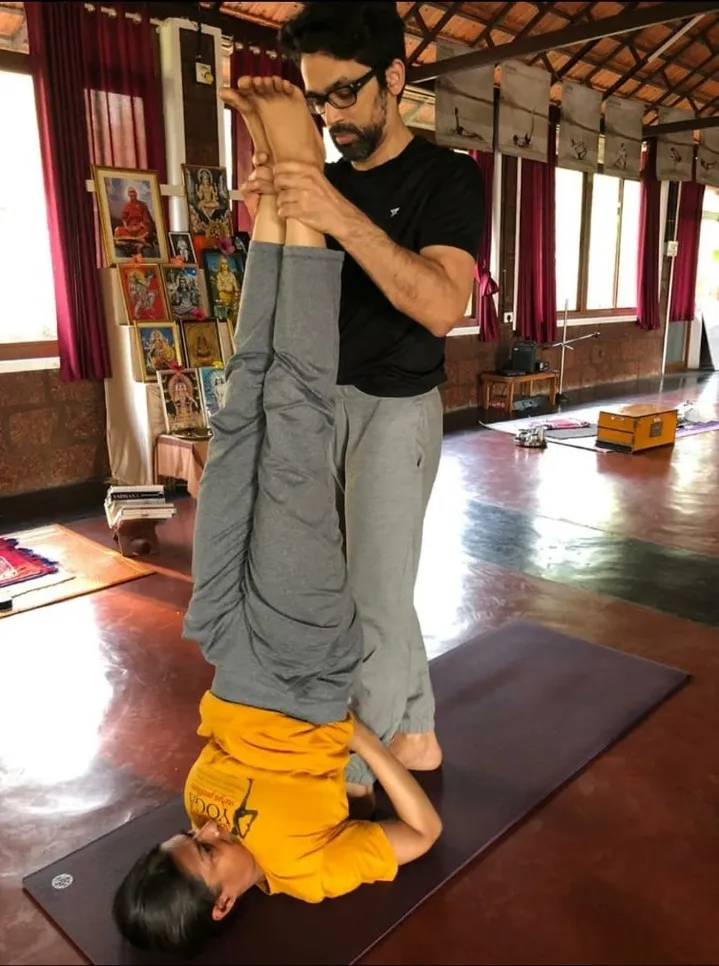
Most of what gets recommended for lower back pain — "just stretch it," "strengthen your core," a generic YouTube flow labelled "yoga for back pain" — treats the back as an isolated part that needs fixing. In fifteen years of teaching and in my own recovery from injury, I've never seen that approach hold up for chronic or recurring pain. The back doesn't work in isolation, and neither does the fix.
This is the difference between yoga as a general practice and yoga therapy as a targeted one. If your lower back pain is a persistent, returning problem rather than a one-off strain, here is what actually tends to move the needle.
Why generic advice fails for chronic pain
Chronic pain is rarely a pure structural problem. After the initial injury or strain, the nervous system often stays sensitized — protecting the area, guarding movement, tightening muscles that don't need to be tight. A generic sequence of forward folds and cat-cows doesn't address that. It can even reinforce the guarding pattern if it's done without attention to how the person is actually breathing and bracing through the movement.
This is why two people with an identical MRI can have completely different pain experiences, and why "just do these five poses" rarely works for anyone beyond the first few weeks.
What a therapeutic approach looks like instead
1. Start with the nervous system, not the muscles
Before any movement, the first work is usually breath and down-regulation — slowing the nervous system out of a guarded, braced state. Pain that has become chronic is maintained as much by the nervous system's threat response as by tissue damage. Ignoring that and going straight to "strengthening" often backfires.
2. Map what actually provokes it
Flexion-intolerant backs and extension-intolerant backs need close to opposite approaches. A private assessment — what position eases the pain, what makes it worse, what time of day it's worst — matters more than any pose. This is the part a generic class or video simply cannot do.
3. Build tolerance gradually, not aggressively
Mobility work is introduced in small, controlled doses, tracking how the body responds over days, not within a single session. The goal in early stages is rarely a deep stretch — it's teaching the nervous system that movement in that direction is safe again.
4. Strengthen what's actually weak
Once the guarding eases, targeted strengthening — often through the deep stabilizers, hips, and posterior chain rather than crunches — rebuilds capacity so the pain has less reason to return.
What to expect from working this way
It's slower than a quick fix, and it should be. Most people who come to Hathayasa with chronic lower back pain have already tried the fast version — a few classes, a foam roller, painkillers when it flares. What tends to actually change the trajectory is a few months of consistent, adapted practice: private sessions or the structured 21-Day Reset programme, built around what your specific back needs rather than a generic sequence.
The practice here isn't decorative. It's built to work — which means it starts with understanding your pain specifically, not applying a template to it.
Dealing with chronic back pain?
A short conversation is enough to tell you whether a private session or the Reset programme is the right starting point.
Message on WhatsApp